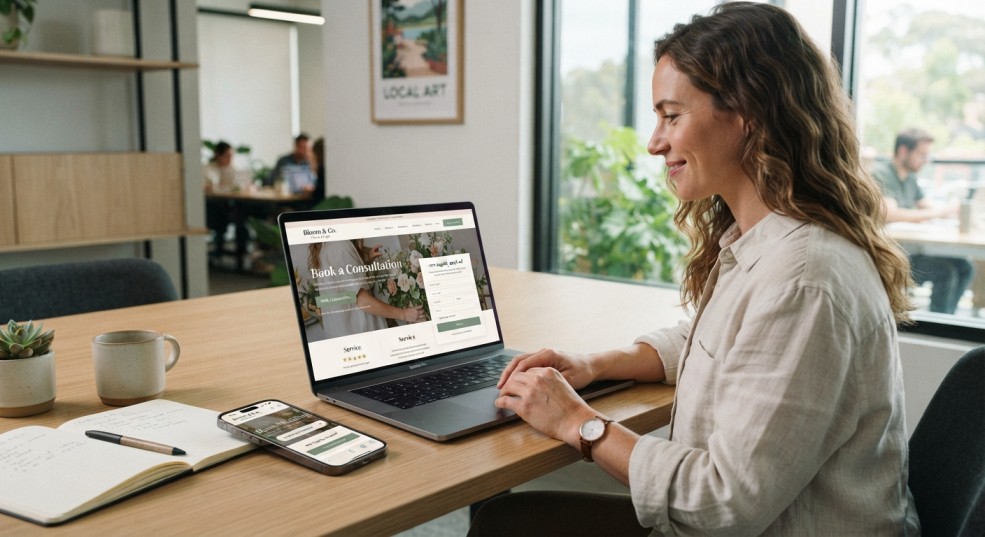
Getting people to visit your website is a good start, but traffic alone does not grow a business. The real opportunity is turning those visitors into people who call, book, request a quote, or buy. Fortunately, you do not always need more website traffic to increase sales. By improving your messaging, user experience, trust signals, and conversion process, you can get more value from the visitors you already have.
1. Understand Why Your Website Visitors Aren’t Converting
A website can attract hundreds or even thousands of visitors and still generate very few customers. If that sounds familiar, the problem may not be your traffic. It may be what happens after someone lands on your site.
Visitors usually leave when they cannot quickly understand what you offer, whether it is right for them, or what they should do next. Slow pages, confusing navigation, weak website copy, unclear pricing, and a lack of credibility can all create friction.
Your bounce rate can give you an early clue. A high bounce rate may indicate that visitors are not finding what they expected or are struggling to engage with the page. However, it is important to look beyond one metric. Analytics can help you understand customer behavior and identify where people lose interest.
2. Understand Your Customer and Their Buyer Journey
Before trying to improve your conversion rate, understand who you are trying to convert.
Think about what your ideal customer wants when they arrive on your website. Are they looking for a quick solution? Comparing several businesses? Researching prices? Or are they ready to contact someone?
This is where the customer journey and buyer journey become important. Someone discovering your business for the first time may need educational information and reassurance. A returning visitor may be much closer to making a purchase.
Customer segmentation can help you create a more relevant experience for different groups. For example, a local service business could have different messaging for homeowners, commercial clients, and customers looking for emergency services.
The better you understand your audience, the easier it becomes to create content and offers that match their needs.
3. Make Your Value Proposition Clear
When someone lands on your homepage, they should not have to figure out what your business does.
Your value proposition should quickly communicate what you provide, who you help, and why choosing your business makes sense. Instead of filling the first section of your website with vague statements about being “the best” or “high quality,” focus on the outcome your customer wants.
For example, a local web design company could say, “Professional websites for small businesses, launched without the complexity of doing it yourself.”
That immediately gives the visitor context.
A strong value proposition also makes the rest of your website copy easier to write because every section supports the same core message.
4. Write Website Copy That Helps People Make a Decision
Good website copy does more than describe your services. It answers the questions that are stopping visitors from taking action.
Conversion-focused copywriting should speak directly to your customer’s problems, explain the benefits of your solution, and remove common objections. Instead of simply listing features, explain why those features matter.
For example, rather than saying a website is “mobile responsive,” explain that customers can easily browse your services and contact your business from their phones.
Keep your language straightforward. Your visitors are not looking for complicated marketing terminology. They want to know whether you understand their problem and can solve it.
5. Give Visitors a Clear Call to Action
A visitor should always know what to do next.
Your call to action (CTA) is the bridge between interest and action. Depending on your business, that action could be “Request a Quote,” “Book a Consultation,” “Call Us,” “Get Started,” or “Shop Now.”
The right CTA depends on where someone is in the buyer journey. A first-time visitor may be more comfortable downloading a guide or joining an email list, while someone comparing your services may be ready to request a quote.
Avoid filling every page with competing calls to action. Give visitors a clear next step that matches the purpose of the page.
6. Build Landing Pages Around One Goal
A dedicated landing page can often convert better than sending every visitor to your homepage.
A good landing page focuses on one specific service, offer, audience, or action. It should explain the problem, present the solution, demonstrate the benefits, provide relevant trust signals, and make the next step obvious.
For example, a local cleaning company could create separate landing pages for residential cleaning, office cleaning, and move-out cleaning. Each page can address the specific concerns of that audience rather than forcing everyone to read the same generic content.
This level of relevance can make your website traffic much more valuable.
7. Use Trust Signals to Remove Doubt
People rarely buy from a business they do not trust.
Even if your offer is excellent, visitors may hesitate if they cannot find evidence that your business is legitimate and capable. Trust signals help reduce that uncertainty.
Customer testimonials are one of the simplest ways to demonstrate real experiences. Case studies can go further by showing the problem a customer had, what your business did, and the result.
Reviews, professional credentials, guarantees, clear contact details, secure payment options, and transparent information can also strengthen credibility.
Place these elements near important conversion points. A testimonial beside a “Get a Quote” button can be far more persuasive than a testimonial hidden on a separate page.
8. Turn Website Traffic Into Leads
Not every website visitor is ready to become a paying customer immediately. That does not mean the visitor has no value.
Lead generation gives people a way to enter your sales process before they are ready to buy. A contact form, consultation request, quote form, newsletter signup, or useful downloadable resource can turn an anonymous visitor into a known prospect.
The goal is to make the first step easy.
Once someone becomes a lead, you can provide helpful information and follow up appropriately. Over time, some of those leads may become qualified leads—people who have a genuine need, interest, and likelihood of purchasing.
9. Personalize the Experience Where It Matters
People respond better to information that feels relevant to them.
Personalization does not have to mean complicated technology. Even simple changes can make a difference. You might show different service recommendations based on the visitor’s needs or create dedicated pages for different customer segments.
For a local business, personalization could be as simple as highlighting services available in a particular area or creating content around the problems faced by a specific type of customer.
When your message reflects customer behavior and intent, visitors are more likely to feel that your business understands what they need.
10. Use Analytics to Find What Is Going Wrong
Guessing is not a reliable conversion strategy.
Use analytics to understand how visitors interact with your website. Look at which pages attract the most website traffic, where visitors leave, which CTAs receive clicks, and which pages generate inquiries or sales.
Suppose one service page receives substantial traffic but almost no inquiries. That page deserves attention. Perhaps the offer is unclear, the CTA is weak, or visitors need more trust signals before contacting you.
The conversion rate is another important metric. It shows how effectively your website turns visitors into people who complete a desired action.
11. Test Changes Instead of Relying on Opinions
A/B testing allows you to compare different versions of a page or element to see which performs better.
You might test two headlines, different CTA wording, a shorter contact form, or alternative page layouts. Rather than deciding which version “looks better,” you can use actual visitor behavior to guide your decision.
You do not need to redesign your entire website every week. Start with the pages that already receive traffic and identify one change that could have a meaningful impact.
Over time, small improvements can add up to a significant increase in your conversion rate.
12. Make the User Experience Fast and Simple
Even the strongest marketing message will struggle if the website is frustrating to use.
Your user experience (UX) should make it easy for visitors to find information, understand your offer, and take action. Pages should load quickly, navigation should be intuitive, and important information should be easy to locate.
Mobile usability is especially important because many customers will discover local businesses through their phones.
Look at your website as a customer would. Can someone find your services quickly? Is your contact information obvious? Can they complete a form without unnecessary effort? If the answer is no, those obstacles could be costing you customers.
13. Follow Up With Visitors Who Aren’t Ready to Buy
Some visitors need more time.
A person might like your service but want to compare alternatives, discuss it with a partner, or wait until the right time to purchase. Instead of treating every non-buyer as a lost opportunity, create ways to stay connected.
Email follow-ups, useful content, reminders, and appropriate remarketing can keep your business in front of interested prospects.
The objective is not to pressure people into buying. It is to provide enough value and reassurance that your business remains a natural choice when they are ready.
14. Turn First-Time Buyers Into Returning Customers
Conversion should not end when someone makes a purchase.
Customer retention is an important part of sustainable growth. A positive post-purchase experience can encourage customers to return, recommend your business, and leave reviews.
Follow up after the sale, make it easy for customers to get support, and continue delivering the quality you promised.
A satisfied customer can become more than a single transaction. They can become a repeat customer, referral source, and source of valuable customer testimonials.
A Simple Website Visitor-to-Customer Framework
The entire process can be simplified into seven stages:
Attract → Engage → Build Trust → Capture → Nurture → Convert → Retain
First, attract the right website traffic. Then give visitors a useful and relevant experience. Build trust through strong messaging and social proof. Capture interested prospects, nurture them when necessary, and make it easy to become a paying customer. Finally, provide an experience that encourages customer retention.
This approach is much more effective than simply trying to increase visitor numbers.
Common Mistakes That Prevent Conversions
Many businesses make the mistake of focusing almost entirely on traffic. More visitors can certainly help, but sending additional people to a website that does not convert simply creates more traffic without solving the underlying problem.
Other common issues include unclear CTAs, generic website copy, weak trust signals, poor mobile UX, confusing navigation, lengthy forms, and failing to review analytics.
Another mistake is changing everything at once. If you completely redesign a website without measuring what changed, you may never know which improvements actually worked.
Start with the biggest obstacles, make targeted improvements, and measure the results.
How Symple Sites Can Help
Your website should do more than give your business an online presence. It should make it easy for potential customers to understand your offer, trust your business, and take the next step.
Symple Sites helps small businesses create professional websites without the complexity often associated with building and managing a website yourself. From website design and copy to mobile-friendly layouts, basic SEO, hosting, and ongoing support, the goal is to give businesses a practical online foundation.
A well-designed website can help turn your existing website traffic into meaningful inquiries and, ultimately, paying customers.
Final Thoughts
Turning website visitors into paying customers is less about chasing more traffic and more about creating a better path from first visit to purchase. Clear messaging, strong CTAs, trust signals, useful landing pages, excellent UX, and ongoing analytics can make that path easier. Start by improving the pages you already have, measure what changes, and keep refining the experience around what your customers actually need.
Frequently Asked Questions
How do I turn website visitors into paying customers?
Give visitors a clear reason to choose your business, address their concerns, build trust, and provide an obvious next step. Strong website copy, effective CTAs, testimonials, landing pages, and a simple user experience can all help improve conversions.
What is a good website conversion rate?
There is no single conversion rate that is considered ideal for every business. Results vary based on the industry, offer, audience, traffic source, and type of conversion being measured. The most useful approach is to establish your current rate and work toward consistent improvement.
Why do I get website traffic but no customers?
The problem could be unrelated to traffic volume. Visitors may not understand your value proposition, trust the business, find the website difficult to use, or know what action to take. Reviewing analytics, customer behavior, website copy, and conversion points can help identify the problem.
How can I increase my website conversion rate?
Start by improving your value proposition and website copy, then strengthen your CTAs, add relevant trust signals, improve the user experience, simplify landing pages and forms, and use analytics and A/B testing to measure improvements.
Do I need more website traffic to get more customers?
Not necessarily. Increasing traffic can help, but improving the conversion rate of your existing traffic can sometimes produce better results without requiring a large increase in visitors. The quality and relevance of your traffic also matter.
What is the difference between a website visitor and a qualified lead?
A website visitor is anyone who arrives at your website. A qualified lead has shown meaningful interest and meets criteria suggesting they may genuinely need or purchase your product or service. Good lead generation helps move relevant visitors toward becoming qualified leads.